
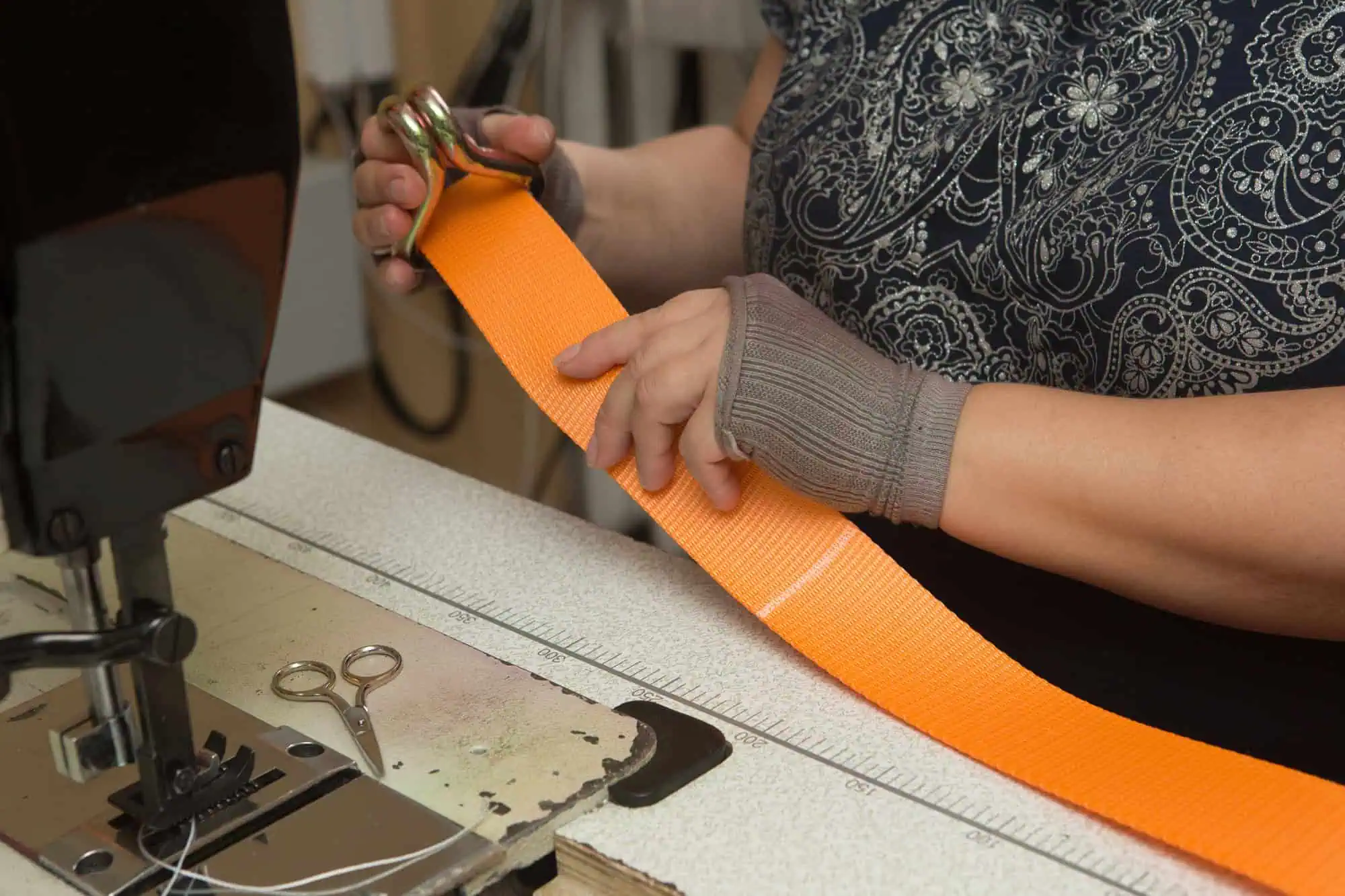
Effective load-bearing strap design begins with understanding that strength is never determined by webbing alone. While material selection matters, the true performance of a finished strap depends just as much on how it is sewn, what thread is used, and how the assembly is constructed.
Overlooking these details can lead to underperforming products, premature failures, and costly redesigns. Understanding how construction choices affect load capacity helps engineers, product developers, and procurement teams build safer, more reliable systems.
This guide explains how stitch patterns, thread type, and webbing selection work together to determine the real-world strength of load-bearing strap design for safety, industrial, military, and transportation applications.
Why Construction Matters in Load-Bearing Strap Design
A finished strap is a system made up of three primary elements:
- The webbing
- The thread
- The stitch pattern
Each component shares the load. If one element is under-engineered, the entire assembly becomes vulnerable.
In many field failures, the webbing remains intact while the stitching fails first. This happens because designers often focus on tensile strength ratings for materials while underestimating how load transfers through sewn joints.
A properly designed strap balances material strength with construction integrity.
Webbing Selection: The Foundation of Strength
Webbing serves as the primary load path in most strap assemblies. Its properties determine how force is distributed and absorbed.
Fiber Type and Performance
Different fibers offer distinct mechanical characteristics:
Nylon
- High tensile strength
- Good elasticity for shock absorption
- Susceptible to UV degradation over time
Polyester
- Excellent UV and moisture resistance
- Lower stretch than nylon
- Strong dimensional stability.
Aramid Fibers (Kevlar®, Twaron®)
- Exceptional strength-to-weight ratio
- High heat resistance
- Limited elongation.
Blended Fibers
- Customized performance profiles.
- Balanced durability and flexibility.
Selecting the appropriate fiber depends on environmental exposure, load dynamics, and safety requirements.
Webbing Width, Thickness, and Weave Structure
Webbing geometry influences both strength and sewability.
- Wider webbing distributes load more evenly
- Thicker constructions improve abrasion resistance
- Tight weaves increase strength but reduce needle penetration efficiency.
Loose weaves sew more easily but may compress under load, reducing long-term durability. Engineers must balance structural performance with manufacturability.
Thread Selection: The Most Common Point of Failure
Thread is frequently the weakest link in load-bearing assemblies. Even high-strength webbing can fail prematurely if paired with inadequate thread.
Thread Materials
Bonded Nylon
- High strength and elasticity
- Good resistance to abrasion
- Vulnerable to UV exposure
Bonded Polyester
- Superior UV and chemical resistance
- Lower stretch than nylon
- Strong long-term stability
Aramid Thread
- Extreme heat resistance
- Exceptional tensile strength
- Higher cost and reduced flexibility
Thread choice should match both the webbing material and environmental conditions.
Thread Size and Tensile Rating
Thread is available in standardized sizes (e.g., Tex, Denier, Commercial sizes). Larger threads provide higher tensile strength but require larger needles and slower sewing speeds.
Undersized thread may pass initial inspection but fail under cyclic loading or shock forces.
Proper thread sizing ensures that stitched joints maintain structural integrity throughout product life.
Stitch Patterns: How Load Is Distributed
Stitch geometry determines how forces are transferred from one webbing section to another.
Common Stitch Patterns
Box-X Stitch
- Widely used in safety and military applications
- Distributes load across multiple directions.
- Provides redundancy
Bar Tack Stitch
- Compact and strong
- Used for attachment points
- Limited load distribution
Straight Lock Stitch
- Efficient for long seams
- Lower redundancy
- Often used in combination with reinforcement patterns
Multi-Row Stitching
- Increases load-sharing capacity
- Improves fatigue resistance
No single pattern is ideal for every application. Pattern selection should reflect load direction, magnitude, and redundancy requirements.
Stitch Density and Spacing
Stitch density refers to stitches per inch (SPI). Higher density improves joint strength but can weaken webbing fibers if overdone.
Excessive needle penetration creates perforation lines that act as tear points. Optimal spacing balances mechanical interlocking with material preservation.
How Sewing Technique Affects Strap Performance
Even with the right materials and patterns, sewing technique plays a major role in final strength.
Tension Control
Improper thread tension can cause loose loops, thread breakage, and uneven load sharing. Balanced tension ensures uniform stress distribution throughout the seam.
Needle Selection
Needle size and tip geometry must match webbing thickness and thread type. Oversized needles damage fibers, while undersized needles increase friction and breakage.
Operator Skill and Automation
Consistent quality depends on trained operators, calibrated machines, and controlled production environments. Automated sewing systems improve repeatability but require careful programming and maintenance.
Load Rating, Safety Factors, and Testing
Designing for strength requires more than material selection. Finished assemblies must be tested under real-world conditions to validate load-bearing strap design assumptions.
Working Load vs. Breaking Strength
- Breaking strength: Maximum load before failure.
- Working load: Recommended operational limit.
Most safety-critical applications use safety factors between 3:1 and 7:1, depending on risk and regulatory requirements.
Destructive and Cyclic Testing
Manufacturers may conduct testing in accordance with ASTM and industry standards, including:
- Static tensile testing
- Fatigue cycling
- Shock loading tests
- Environmental exposure testing
These evaluations validate design assumptions and reveal weak points before production.
Environmental Factors That Influence Long-Term Strength
Operating conditions affect both materials and stitching over time. Key stressors to account for in load-bearing strap design include:
- UV radiation
- Moisture and salt exposure
- Chemicals and oils
- Extreme temperatures
- Abrasion
Designers must consider degradation over time, not just initial performance.
Designing for Manufacturability and Consistency
High-performing load-bearing strap designs must also be scalable. Early collaboration with manufacturers allows teams to:
- Optimize stitch layouts
- Select compatible materials
- Reduce tooling complexity
- Improve production repeatability
Small adjustments during the design phase often prevent costly revisions later.
Load-Bearing Strap Design Guidelines for Engineers and Buyers
When specifying load-bearing strap design for safety-critical applications, follow these best practices:
- Match thread strength to webbing capacity
- Use redundant stitch patterns for critical joints
- Avoid excessive stitch density
- Specify testing requirements upfront
- Document environmental exposure conditions
- Validate designs with prototype testing
Following these principles improves reliability and reduces long-term risk.
Building Safer, Stronger Load-Bearing Strap Systems
Load-bearing strap design succeeds or fails at the seams. True strength emerges from the interaction between webbing, thread, stitch pattern, and manufacturing quality.
By understanding how these elements work together, designers and buyers can create assemblies that perform consistently under demanding conditions.
Partnering with experienced manufacturers who control weaving, sewing, and testing processes ensures that strap systems meet both technical and operational expectations — from first article to full-scale production. Explore ACW’s industrial sewing and strap capabilities or contact our engineering team to discuss your application.
Understanding which standard drives your program prevents over-engineering or under-specifying.