
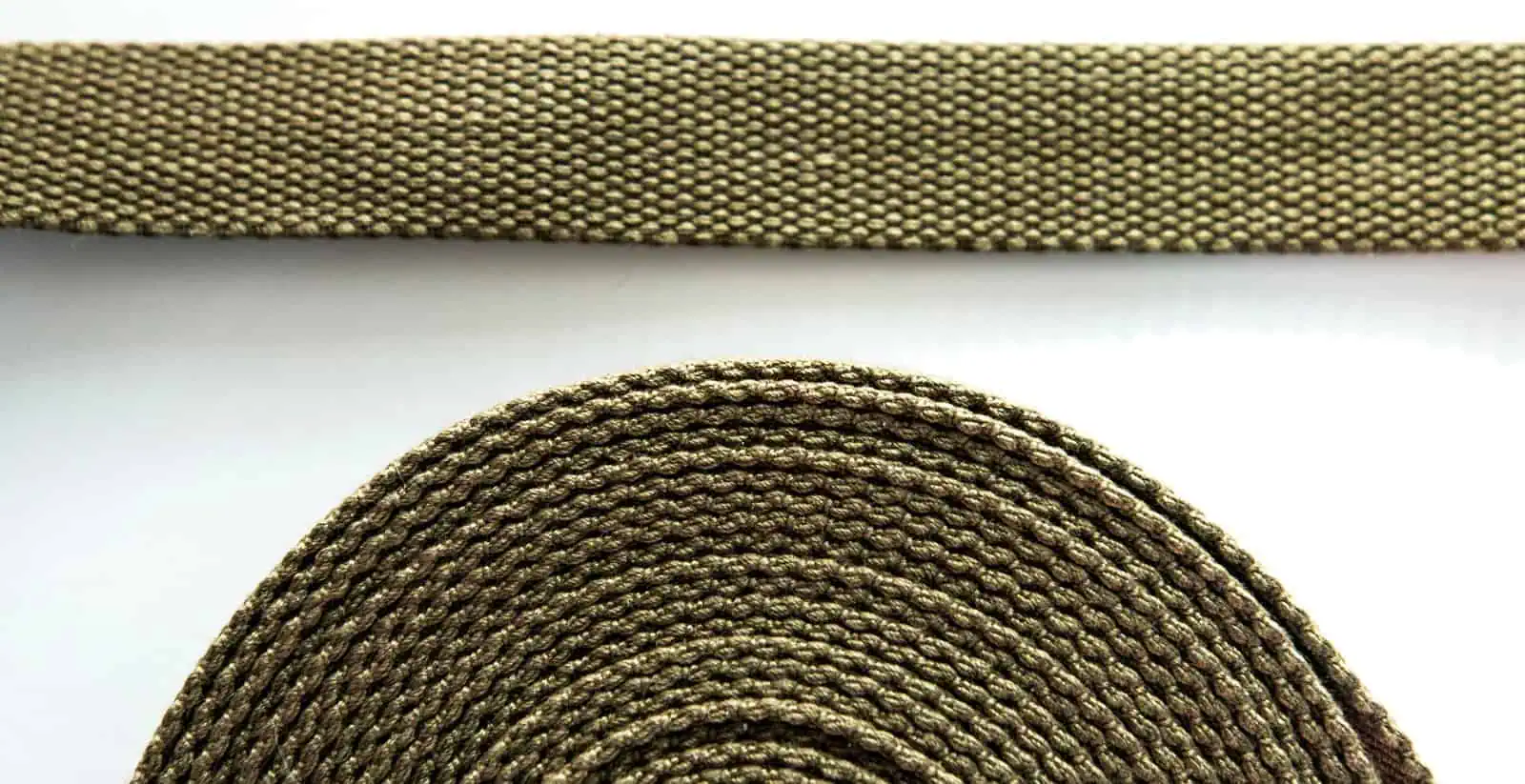
In industrial manufacturing, precision applies for more than machined parts. For example, there are critical applications for woven materials such as safety harnesses, cargo restraints, and medical supports where the dimensional accuracy of webbing, cord, buckles, fasteners, and accessories are held to precise standards. And the way that accuracy is communicated and controlled comes down to one key concept: webbing tolerances.
What Are Webbing Tolerances and Why Do They Exist
Webbing tolerance refers to the allowable variation in the finished dimensions of woven tapes. Common tolerances are applied to width and thickness, though others exist such as roll length and pH of the webbing. Because webbing is made from woven yarns under tension, slight variations naturally occur across production runs.
Tolerances define how much that variation might deviate from the specified nominal size; for example, say, a 1.0 inch webbing could measure slightly wider or narrower once produced and finished. Usually in these cases +/- of 1/16” or 1/32” is an acceptable tolerance. With this in mind, oftentimes the failure point of the width variations will occur when threading your webbing through hardware which has much smaller width tolerances, usually around + 1/64”.
Establishing tolerances:
- Ensures fit with mating components (buckles, guides, or sewn assemblies)
- Maintains consistency in automated or multi-part assemblies
- Helps manufacturers monitor process control and detect drift or wear in weaving equipment
- Wider and thicker webbings have larger acceptable variations
Without defined tolerances and close monitoring during processing, small dimensional errors will cascade into fitting issues, products with premature wear, and functional failures downstream.
Why Tighter Webbing Tolerances Matter
When webbing interfaces with hardware or assemblies, even small dimensional differences affect performance.
- Fit and Function: A webbing that’s too wide will not feed smoothly through a slot or buckle. When too wide, it can slip or rattle under load.
- Repeatability: Automated stitching or cutting systems rely on consistent input dimensions for clean seams and predictable lengths.
- Wear and Load Distribution: Variance in width alters how loads distribute across the webbing cross-section and affect wear rates and long-term durability.
- System Reliability: In safety-critical environments such as harness assemblies for military, aerospace, or rescue applications, tolerance drift compromises trust in the entire system’s functionality.
In short, tolerance does not make webbing “better,” but it does make it more predictable, which is what engineers often need when performance margins are tight.
Application Examples:
Consider two examples that show why tolerance selection ought to match application demand:
- Military and Safety Harness Systems
A harness design calls for 1.75-inch webbing to pass through friction buckles with tight clearances. If the webbing arrives 1.80 inches wide, assembly becomes difficult, and users might struggle with adjustment in the field. Here, a tight tolerance ensures smooth operation without compromising material strength. These systems must also comply with OSHA fall protection standards, where dimensional consistency directly impacts equipment certification and field reliability. - Industrial Conveyor Straps
For conveyor tie-downs or support webbing that loops around rollers, dimensional flexibility is less critical. A larger tolerance provides consistent performance while maintaining cost efficiency. Slightly broader variation won’t affect function.
In both cases, performance doesn’t hinge on “tight” or “loose” tolerances alone. They depend on how those tolerances align with the end user’s application.
How Tolerances Affect Downstream Manufacturing
Tolerance selection also shapes the ease and cost of downstream operations.
- Sewing and Assembly: Tighter tolerances reduce setup changes and minimize rework when multiple webbings must align precisely in stitched assemblies.
- Hardware Integration: Mating webbing to metal or plastic hardware demands repeatable fit to avoid jamming or slippage.
- Automation Compatibility: Robotic systems that cut, feed, or insert webbing benefit from uniform width control that maintain accuracy at scale.
The Role of Manufacturing Control
Achieving consistent tolerance is a function of both process control and manufacturing environment.
Factors influencing dimensional accuracy include:
- Yarn selection and denier uniformity
- Loom tension, speed, and humidity control
- Finishing methods such as heat setting, dyeing, or coating
- Quality inspections and process monitoring. Testing protocols such as ASTM D6775 provide standardized methods for measuring webbing width, thickness, and breaking strength to verify tolerances are held across production runs.
As a premier U.S based webbing manufacturer and buckle manufacturer, ACW maintains in-house control of these variables. From yarn sourcing through weaving and finishing, consistent ACW monitoring means avoiding the errors that occur when different products are involved. This allows not only adherence tight tolerance classes, for military, aerospace, safety and flotation but also predictable repeatability across production runs.
Because every webbing line and application differ, early engineering collaboration matters. When customers work with ACW during the design phase, our team will recommend the right tolerances upfront to reduce risk of dimensional surprises during integration or testing.
Why Early Consultation Pays Off
Tolerance issues often surface after customers buy the webbing and the products are actively in assembly/production lines or prototype testing. This is when retooling or redesigning is more costly and can cause manufacturers to have lines completely down caused by a small cost product. By discussing tolerance requirements early, engineers:
- Align webbing specs with mating component geometry
- Balance functional and economic trade-offs
- Preempt assembly friction or feed issues
- Reduce down time on your production floor
Working directly with a manufacturer that understands both material behavior and production control saves time and mitigates costly downstream fixes.
The Takeaway
Webbing tolerances differ by fractions of inches, but those fractions determine whether a part slides smoothly, holds securely, or fits reliably into an assembly. Understanding and specifying the right tolerance level is key to performance, safety, and efficiency in applications and ultimately can avoid downtime and major disruptions in your operations.
When tolerance control is critical, it pays to consult early with a manufacturer that not only weaves webbing but understands how dimensional accuracy translates into real-world reliability.