
A Guide to Types, Materials, Strength and Applications
A side-release buckle may be one of the simplest pieces of hardware on a strap, but its design provides an important solution: how to securely connect two pieces of webbing while allowing the user to release them quickly and easily.
You see side-release buckles in use everywhere, from backpacks, luggage and outdoor equipment to pet collars, safety gear, medical products, and industrial applications. Sometimes called quick-release buckles, they are designed for fast, repeatable connection and release.
But how exactly does a side-release buckle work? And how do you know which type, material, and size is best for your application?
American Cord & Webbing manufactures and supplies side-release buckles in a variety of configurations, materials and sizes, with the ability to develop custom hardware for specialized applications.
How Does a Side-Release Buckle Work?
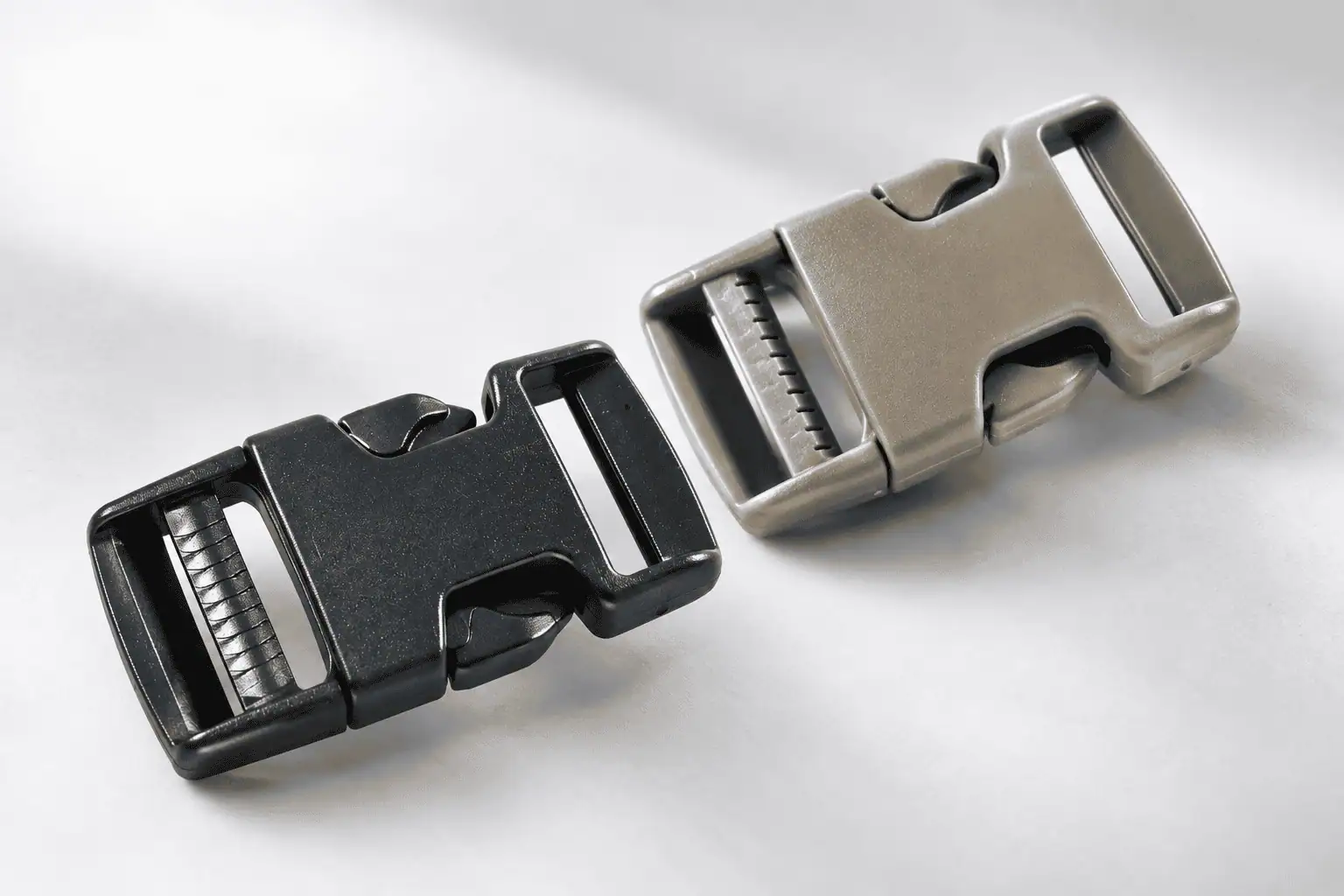
The basic design consists of two components: 1- a male, also called the latch and 2- female, also called the body.
The male component has flexible arms or locking tabs. When it is pushed into the female component, those tabs move inward and then spring back outward into position once they pass the locking point inside the body.
This creates that familiar “click” telling users the buckle has engaged.
To release it, the user squeezes the two side tabs. This moves the locking arms inward and allows the male component to slide out of the female receiver.
The clever part of the design is that the buckle uses the natural flexibility of the material composing it to create a spring-like locking action without requiring a separate spring mechanism.
Why Are Side-Release Buckles So Popular?
Side-release buckles have useful characteristics.
- They’re fast and easy. Users can connect and disconnect a strap quickly and with one hand.
- They’re reusable. Unlike permanent fasteners, they can be opened and closed repeatedly.
- They’re adjustable. Many designs incorporate one or two strap-adjustment points, allowing the length of the webbing to be changed.
- They’re compact. A side-release buckle provides a secure connection without adding substantial weight or bulk.
- They’re versatile. They can be manufactured for everything from lightweight consumer products to demanding heavy duty industrial and specialty applications.
- They’re strong. ACW’s 1” MSR side release buckle has a tensile strength of 300 lbs and the T-1 Bullet has a tensile strength of 500 lbs.
Side-release buckles are available in numerous configurations, including standard, curved, streamlined, dual-adjusting and contoured designs.
Side-Release Buckle Types
Choosing the right design starts with understanding how the buckle will be used.
Standard Side-Release Buckles
The standard design is the familiar male-and-female buckle used on backpacks, bags, straps, and other products.
It’s a good general-purpose choice when a simple, dependable quick-release connection is needed.
Adjustable Side-Release Buckles
Adjustable versions incorporate an extra loop that allows the webbing to be lengthened or shortened.
These are particularly useful when the finished product needs to accommodate different users or fit requirements.
Dual-Adjusting Buckles
A dual-adjusting buckle allows adjustment on both sides of the buckle. This provides greater flexibility for positioning and tensioning a strap.
Curved Side-Release Buckles
Curved designs are shaped to follow the contour of products or the body.
They’re commonly found on products such as pet collars and other applications where a curved strap needs to sit comfortably against a surface.
Low-Profile and Specialty Designs
Some applications call for smaller, lighter, or more streamlined buckles. Specialty designs reduce bulk while maintaining the basic side-release operating principle.
For products with unique dimensions, loads, aesthetics or operating requirements, a custom buckle will be a better solution.
Choosing the Right Buckle Size
Side-release buckles are commonly specified according to the width of the webbing they are designed to accommodate.
Common sizes range from approximately ½ inch through 2 inches, although availability varies by design and manufacturer. Commercial side-release buckle lines include sizes such as 5/8″, ¾”, 1″, 1¼”, 1½” and 2″. Should you need a custom design, contact ACW for immediate help with design and production, as well as quotes.
Match the buckle to the width and construction of the webbing.
Width isn’t the only consideration for your buckle. Webbing thickness, flexibility, weave, material, and the way the webbing is attached to the buckle influence performance, functionality, and durability.
For that reason, selecting a buckle based solely on just its width isn’t enough for demanding applications.
Plastic Side-Release Buckles: Acetal vs. Nylon
Plastic is especially popular for side-release buckles because it combines low weight, corrosion resistance, durability, and design flexibility.
Acetal
Acetal, also known as POM or polyoxymethylene, is widely used for precision plastic hardware because of its stiffness, low friction, and dimensional stability.
Acetal is an excellent choice when a buckle needs to provide a smooth release action, maintain its shape, and withstand repeated use.
Acetal has exceptional tensile strength and would be used in applications exposed to the elements.
Nylon
Nylon is another common material for buckle construction. Depending on the formulation and design, nylon provides excellent toughness and impact resistance.
Different applications will demand different material characteristics, which is why manufacturers often offer side-release buckles in both acetal and nylon formulations.
Nylon has exceptional impact strength and would be used in applications where impact resistance is needed.
How Strong Is a Side-Release Buckle?
This is where buyers need to be careful.
There is no single “strength rating” for side-release buckles.
Strength depends on:
- Buckle design
- Material
- Buckle size
- Webbing width and thickness
- Webbing material
- Attachment method
- Direction of loading
- Environmental conditions
- Manufacturing tolerances
- Whether the load is static, dynamic, or shock-loaded
Published values, when you find them, will dramatically vary. For example, commercially available plastic side-release buckles have substantially different tensile-strength specifications even when sizes are similar.
Some specialty side-release designs are engineered for much higher loads; one ACW-lists a 1-inch design, for example, the T-1 Bullet has a break strength near 500 pounds.
Never assume that a 1-inch buckle from one manufacturer has the same strength as another manufacturer’s 1-inch buckle.
For safety-critical applications, the complete strap-and-hardware assembly must be evaluated and tested for its intended dynamic use.
What Applications Use Side-Release Buckles?
Because they’re easy to operate and adaptable for many strap systems, side-release buckles are used across a wide range of products.
Common applications include:
- Backpacks and bags
- Luggage
- Outdoor and recreational equipment
- Pet collars and harnesses
- Medical and orthopedic products
- Sporting goods
- Protective equipment
- Tactical and Military
- Industrial straps
- Child and consumer products
- Commercial Workwear
- Specialty sewn products
The right buckle depends on the demands for the finished product.
When Should You Choose a Side-Release Buckle?
A side-release buckle is an excellent choice when you need a repeatable connection that can be opened and closed quickly without tools.
It is particularly useful when:
- The user needs frequent access. A backpack, harness, or equipment strap that needs to be opened hundreds of times, for example.
- Speed matters. Side-release buckles operate much faster than other latch systems.
- The strap needs adjustment. Adjustable versions of these buckles accommodate different sizes and configurations.
- Weight matters. Plastic buckles provide excellent functionality without the weight of metal hardware.
- Corrosion is a concern. Plastic hardware won’t rust or corrode like conventional metal hardware.
- When a Standard Buckle Does Not Work
Sometimes an off-the-shelf buckle is not workable. Talk to us about customization for the right answer.
Perhaps the webbing is an unusual width. Maybe the product requires a specific load capacity, appearance, release force, color, or environmental sustainability. Or perhaps the buckle needs to fit a unique molded or sewn assembly.
This is where working directly with ACW makes the difference.
Custom Side-Release Buckles from American Cord & Webbing
American Cord & Webbing offers more than standard strap hardware. ACW manufactures buckles in-house, providing the ability to work with customers on specialized hardware requirements.
Custom manufacturing can help address requirements involving:
- Unique dimensions
- Specialized strap widths
- Custom colors
- Branding and identification
- Specialized geometries
- Performance requirements
- Application-specific designs
Instead of trying to make an existing buckle work for a product, manufacturers work with us for a hardware solution designed around the product.
How to Choose the Right Side-Release Buckle
Before selecting a buckle, consider these questions:
- What is the webbing width?
Start with the strap. A buckle must be compatible with the webbing dimensions. - What load will the buckle experience?
Determine the expected working load and whether the application involves shock or dynamic forces. - What materials are appropriate?
Acetal, nylon Fireloc each offer different performance characteristics. - How often will the buckle be cycled?
Frequent-use products benefit from design optimized for smoothness and durability. - What environment will it encounter?
Consider exposure to UV, moisture, chemicals, temperature fluctuation, and abrasion. - Does it need adjustment?
Choose between fixed, single-adjusting, and dual-adjusting configurations. - Is a standard design sufficient?
If not, consider a custom solution.
The Bottom Line
While a side-release buckle is deceptively simple its job is to provide a secure connection when closed and an easy release for opening.
The right buckle, however, depends on size, material, webbing compatibility, loading, environment, and application.
Whether you need a lightweight plastic side release buckle for a consumer product, a rugged metal buckle for demanding equipment, or a specialized design for a unique application, selecting the right hardware makes the difference in performance product finish.
Rely on American Cord & Webbing to get you the right solution—or develop one specifically customized for your application.