
The canopy slows you down. The webbing decides whether the load reaches your skeleton in a survivable way. Here’s how Type 26 does its job.
Every skydiver trusts their life to a canopy. But somewhere beneath the nylon and suspension lines, doing absolutely no showboating whatsoever, is the material that quietly determines whether physics delivers its verdict gently or catastrophically. That material is Type 26 webbing — and it deserves a lot more credit than it gets.
Opening Speed
Peak Load Spike
Handles All of It
What Is Type 26 Webbing?
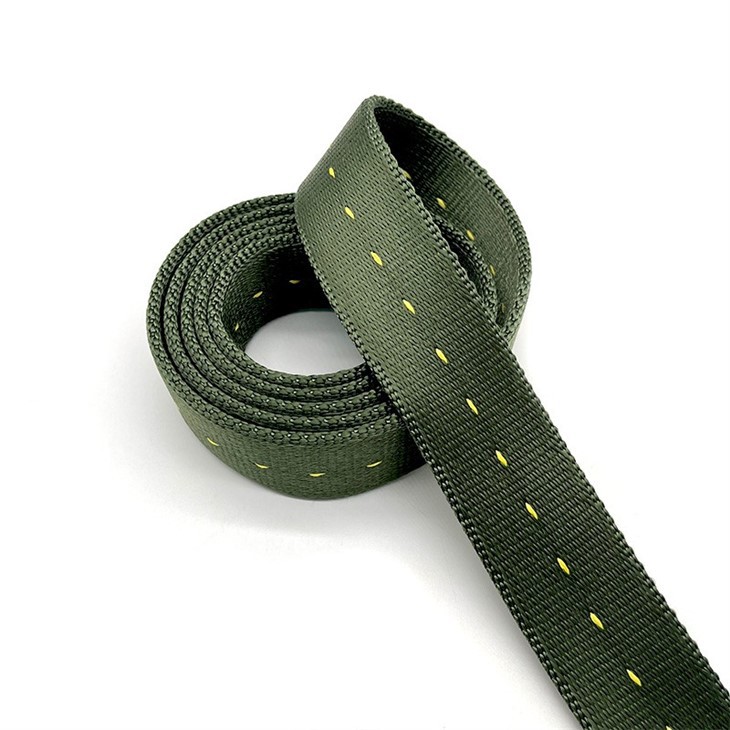
Type 26 is a high-strength nylon webbing, roughly one and three quarter inch wide, developed under U.S. military specifications. Its reputation rests on three qualities that matter enormously when someone is falling at terminal velocity: a remarkable strength-to-weight ratio, excellent flexibility, and consistent, predictable stretch under load.
That last quality — predictable stretch — is easy to overlook until you understand what’s happening during a parachute deployment. When you hit the end of the opening sequence at 120 mph, the system has milliseconds to convert kinetic energy into something your body can survive. Materials that behave unpredictably under shock loads are the enemy. Type 26 is not that.
01 Harness Construction
The harness is, at its core, a load distribution problem. When a canopy opens, force can spike to 1,000–3,000 pounds in a fraction of a second. If that force were delivered through a single narrow strap, bones would lose the argument. Engineers route webbing around the body to spread the impact across a survivable surface area:
- Shoulder straps
- Chest webbing
- Leg straps
- Main lift webs
Type 26 gives engineers what they need: tensile strength sufficient for the peak loads, combined with enough flexibility to be sewn into complex, body-conforming harness assemblies.
“The canopy gets all the glory. But the webbing is often the real hero — deciding whether the load gets delivered to your skeleton in a survivable way.”
02 Connector & Structural Webbing
If the harness is the load distribution system, think of the structural webbing as the skeleton. Inside parachute assemblies, Type 26 appears as load transfer straps, attachment points between the harness and container, and reinforcing structures buried inside the pack itself.
The canopy catches air. The webbing handles the mechanical consequences. These are different jobs, and the material needs to be chosen accordingly.
03 Container Systems
Modern sport and military parachute containers are not passive bags — they’re structural assemblies that experience significant tension during opening and deployment. Type 26 reinforces these structures in several ways:
- Container frame support
- Flap reinforcements
- Internal structural straps
Because of its strength-to-weight ratio, Type 26 adds load-bearing capacity without contributing bulk that would compromise the jump.
04 Risers & Load Interfaces
Risers are the critical interface where forces generated by the canopy transition into the jumper’s harness — the most mechanically loaded connection in the system. While heavier webbing types are sometimes specified here, Type 26 sees use in riser assemblies where its elongation characteristics are an advantage.
Nylon webbing stretches slightly under load, and in this context that’s a feature, not a flaw. That controlled elongation absorbs shock energy during canopy inflation instead of transmitting it directly to the jumper’s body.
05 High-Stress Point Reinforcement
In parachute design, wherever engineers expect repetitive load cycles, they add webbing. Type 26 is commonly sewn into high-wear zones, including:
- Bartack areas
- Hardware attachment points
- Quick-release systems
- Reserve deployment structures
06 Why Type 26 Specifically?
The parachute industry is famously conservative about materials — and for obvious reasons. A design change requires extensive testing because the stakes of failure are as high as they can be. Type 26 became the standard because it combines properties that rarely overlap in a single material:
Exceptional load capacity relative to its 1.75 inch width
Withstands thousands of load cycles without degradation
Predictable stretch under load — no surprises
Integrates cleanly into complex textile assemblies
Adds structural capacity without adding mass
Tested and trusted across aerospace applications
The MIL-SPEC rabbit hole goes deep. Standards like MIL-W-4088 define a family of webbing types — Type 7, Type 8, Type 13, and others — that appear across aerospace and defense applications far beyond parachutes. NASA uses many of the same webbing families in spaceflight harness systems.
When astronauts launch into orbit, a significant portion of the load-bearing textile technology protecting them traces its lineage back to parachute webbing developed decades ago. Fabric, quietly holding together some very high-stakes adventures.
Textile Engineering as Structural Engineering
There’s a deeper truth buried in all of this that anyone with a background in cord and webbing manufacturing will appreciate. Parachute systems are one of the most elegant demonstrations of textile engineering behaving as structural engineering. Fabric acting as load-bearing structure — not metaphorically, but literally. The math that governs a steel beam also governs a nylon harness strap. The materials are different; the physics are the same.
Type 26 webbing isn’t glamorous. It doesn’t have a Wikipedia page with thousands of edits. But every time a parachute opens cleanly and a jumper walks away from the landing zone, this quiet strip of nylon had something to do with it.
At ACW, this is exactly the kind of engineering we think about every day — materials that do extraordinary work without asking for recognition.
Need MIL-SPEC or Parachute-Grade Webbing?
ACW manufactures parachute-specification webbing right here in the USA, Berry Amendment compliant, from our Rhode Island facility.